Sam
Lord of the FliesSam is one half of the nearly inseparable pair Sam and Eric. The narrative first presents them through their striking resemblance and synchronized behavior, then gives their twin bond practical importance: they share responsibility for the signal fire and, by the boys’ custom, speak at an assembly through a single conch. Their mistaken report of the beast helps intensify the community’s fear, while their later capture shows how little protection their unity can offer against the tribe’s growing coercion.
First appearance and twin identity
Sam arrives with Eric among the last boys to reach the assembly. Both are fair-haired, sturdy, and visibly exhausted; they fling themselves down, panting and grinning at Ralph. Their resemblance is so complete that the sight of them together is described as startling. Piggy tries to learn their names, repeating them in turn, but becomes confused. The twins correct him by shaking their heads and pointing at one another, prompting laughter from the assembled boys. The moment establishes an identity that the group initially finds funny: Sam is recognizable, but not easily separated from his twin.
That closeness persists as more than appearance. Sam and Eric breathe and grin together, and later struggle to do tasks independently when independence would require them to stay awake alone. Their bond is treated by the group as a practical fact as well as a source of amusement. At a later assembly, the boys accept a single conch for both of them, recognizing their substantial unity. Sam’s voice in public is therefore commonly joined to Eric’s, even when the account identifies one twin as beginning a particular part of their report.
Hunting and the unattended fire
Sam and Eric reappear in the procession returning from a successful hunt, carrying a stake across their shoulders with the gutted pig swinging between them. The hunt has taken place while the signal fire went out and a ship passed beyond the boys’ reach. When Ralph confronts the returning hunters, Jack Merridew is eager to recount the kill, while Ralph insists on the consequence of neglecting the fire. The twins’ visible part in carrying the carcass places them within the hunting group’s excitement, against the urgent rescue duty that has been abandoned.
Their next explicit responsibility is to tend that fire. During the night, Sam and Eric are both supposed to be on watch, although the arrangement expects one twin to sleep while the other stays awake. They cannot manage the task independently and both fall asleep. When they wake, they find only a dark smudge where the fire should be. Eric thinks it may be out; Sam brings tinder and branches to the hot spot, and together they get a small fire burning again. Their brief exchange over the wood shows the practical, shared nature of their work: one feeds the glow while the other cautions against using too much fuel. The fire is saved, but their account makes clear how close it came to going out while they slept.
The mistaken sighting
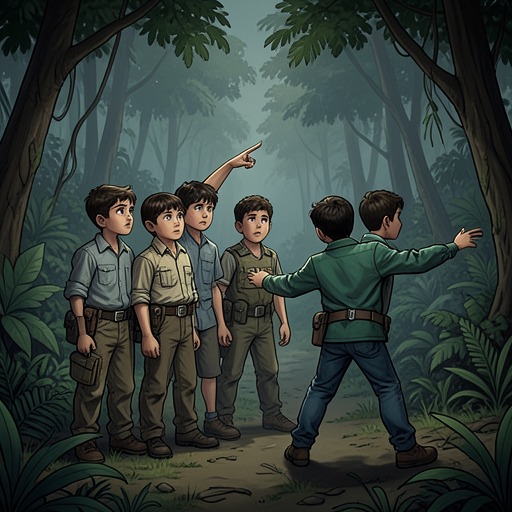
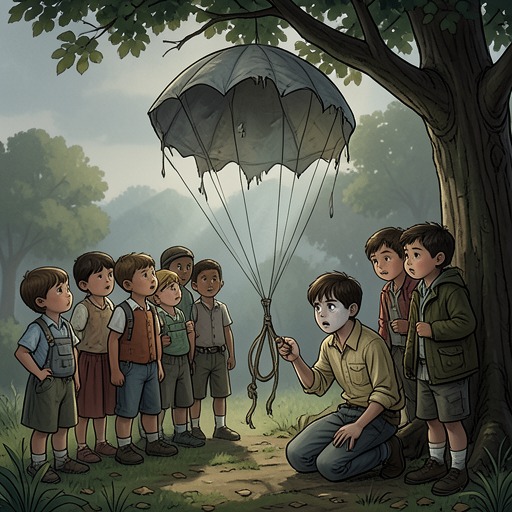
During that same watch, the parachutist’s body has been carried by the wind to the mountain-top. As the lines of the parachute pull and slacken, the figure’s head and chest rise and sink in the dark, giving it the appearance of a creature moving. At dawn, Sam and Eric approach the place where they have been tending the fire and see the figure. They interpret it as the beast and flee, stumbling through the brush; Eric’s face is scratched and striped by the branches.
When Ralph calls an assembly, Sam and Eric insist they were not asleep when they saw the creature. Eric takes the conch and Sam begins their account; the shell is understood to serve both twins. They describe fur, movement behind the head, wings, eyes, teeth, and claws, and say the beast followed them. Their terror, together with Eric’s visible scratches, makes the account persuasive to the other boys. The report is mistaken—the figure is the parachutist—but the twins do not know this. Their testimony gives the boys’ fear a vivid scene and apparent eyewitness authority, helping turn an unseen threat into something the group believes it has encountered.
A community divided
As Jack Merridew breaks from Ralph’s group, the old arrangements of shared responsibility give way to competing allegiances. During the raid on the fire, Sam and Eric watch together from beside a palm tree as masked figures rush in, seize half-burnt branches, and run off. The scene places the twins at the edge of the action, still together, while the boys’ communal means of keeping a signal fire begins to be appropriated by Jack Merridew’s group.
Their position becomes more dangerous when they accompany Ralph’s party to demand Piggy’s glasses and insist that the signal fire must be maintained. At Castle Rock, Jack Merridew orders the twins to be seized. The group takes their spears and ties them up; the boys who carry out the order discover the power they hold over captives. The change from familiar companions to prisoners is abrupt. The twins’ paired identity, once a harmless source of laughter at the first assembly, now marks two boys caught together in a struggle between rival groups.
Capture and narrative significance
After Piggy’s death and the destruction of the conch, Jack Merridew tells Sam and Eric that they must join his tribe. He prods Sam with one of the remaining spears and demands to know why they have not joined; Sam protests that this is not the way to treat them. Eric remains beside him, and the twins lie looking up in quiet terror as Roger advances on them with an authority the narration presents as difficult to name. The episode records coercion, not a willing change of allegiance: their shared presence does not prevent their confinement or make their resistance safe.
Sam is given little separate identity from Eric, and that limitation is central to his portrayal. Their twin bond appears first as visible likeness and comic confusion, then as a working partnership at the fire and a shared witness to the supposed beast. As the boys’ society breaks apart, the same closeness leaves them together in flight, in testimony, and in captivity. Through Sam and Eric, the story traces the narrowing space between collective belonging and enforced obedience.